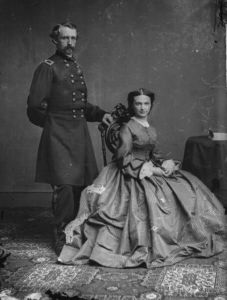
Love. There was nothing else to marry a soldier for.
Elizabeth Custer
Back in 2011, I set up a simple blog to write about the research I was doing about the life of Elizabeth Bacon Custer. Since then, I have finished a historical novel which will be published in October or November 2026.
I know. A long time to be involved with the subject.
I started reading about the Custers because of my interest in the history of the American West. It was the history of my country, but also of my family. English ancestors arrived in New England in the early 1600s. Evidently, one group came, not on the Mayflower, but on the second or third boat. I guess there was a limit to the level of adventure they could manage. But by the turn of the Twentieth Century, my mother’s people were in San Francisco and shortly after World War I, my father’s were in Los Angeles.
None were career military, though several did fight in the Revolution and the Civil War. The majority were professional men: ministers, lawyers, and doctors. My father claimed to be the first engineer.
He was a petroleum engineer and in April of 1945, almost the minute the war in Europe was over, he flew to Saudi Arabia to join the Arabian American Oil Company. Aramco. My mother, sister, and brother arrived on Halloween 1946 and I was born in Dhahran, the company headquarters, in 1949.
The American employees had been there through World War Two, lived in military-type housing, ate in dining halls, and dressed in khaki. For their families to join them, houses had to be built in the desert. Water, electricity, and especially air conditioning, along with all the other elements of an American town: schools, clinics, and offices. Each of three original towns also boasted a club house with pool, bowling alley, library, and dining hall.
Reading about the families of the Indian War army, their lives reminded me of Aramco. We, like them, felt very, very far away from home in the States. Of course, we were. Saudi Arabia is halfway around the world from California. Letters took a week or ten days, magazines and newspapers were always late, and a telephone call crackled via the Atlantic cable.
If your husband was stationed at Fort Hayes in Kansas or Fort Stockton in West Texas, you experienced much the same isolation and hardship. For example, there might be a doctor at the larger posts, but none were gynecologists. Not to mention pediatricians. Perhaps there was a pastor; and in the early days, there were no schools or teachers. Many parents faced the emotional and economic worries of sending older children to school in the States. Same for us in Arabia when we reached high school.
As with Aramco in the early days, there were few vegetables, fresh milk, eggs or butter in the commissary. Clothing, household necessities, and anything special like Christmas or birthday gifts had to be gotten elsewhere. There was a great deal of “making do.”
Of course, the biggest difference was we were not in danger from the Saudis. At least, not in our three little towns. They, for the most part, didn’t see us as enemies. Or we them. We were there as their partners, building an industry.
The wives of the army officers in the 1860s postwar period were primarily middle and upper middle class, most with good educations. Many of the wives wrote memoirs and many of them wrote about the Custers. Libbie famously wrote three: “Boots and Saddles or Life in Dakota with General Custer” published 1885, “Tenting on the Plains. Or, General Custer in Kansas and Texas,” 1887, and “Following the Guidon,” 1890.
It fascinated me perhaps because it felt so familiar.
 Margot Abbott
Leave a comment